96% of Pump.fun Traders Made Less Than $500 in March
New data from 1.4 million wallets reveals that over 50% of Pump.fun traders lost money in March 2026, while 250 deployers extracted $79 million. Here's what the numbers actually say.

Let me save you some time. If you traded on Pump.fun this month, there's a 96% chance you made less than $500. And a coin flip's chance you lost money outright.
That's not my opinion. That's what 1.4 million wallets just told us.
The Numbers Nobody Wants to Hear
A Dune Analytics dashboard compiled by analyst @oladee tracked roughly 1.4 million wallets that traded Pump.fun tokens in March 2026. The results are about as cheerful as you'd expect.
50.6% of wallets finished the month in the red. Not breakeven. Not "I made a little." Negative. Gone.
Another 45.6% technically made money, but capped at $500. For a month of trading. After gas fees, after slippage (the price moving while your transaction processes), after the emotional cost of staring at charts at 3 AM, most of these wallets probably netted the equivalent of a grocery run.
Add those two groups together: 96% of all Pump.fun traders either lost money or made less than $500 in a full month of trading.
Two wallets made over $1 million. Two wallets also lost between $500,000 and $1 million. The extremes are wild, but the middle is where most people live, and the middle is brutal.
Where Did the Money Go?
Here's where it gets ugly.
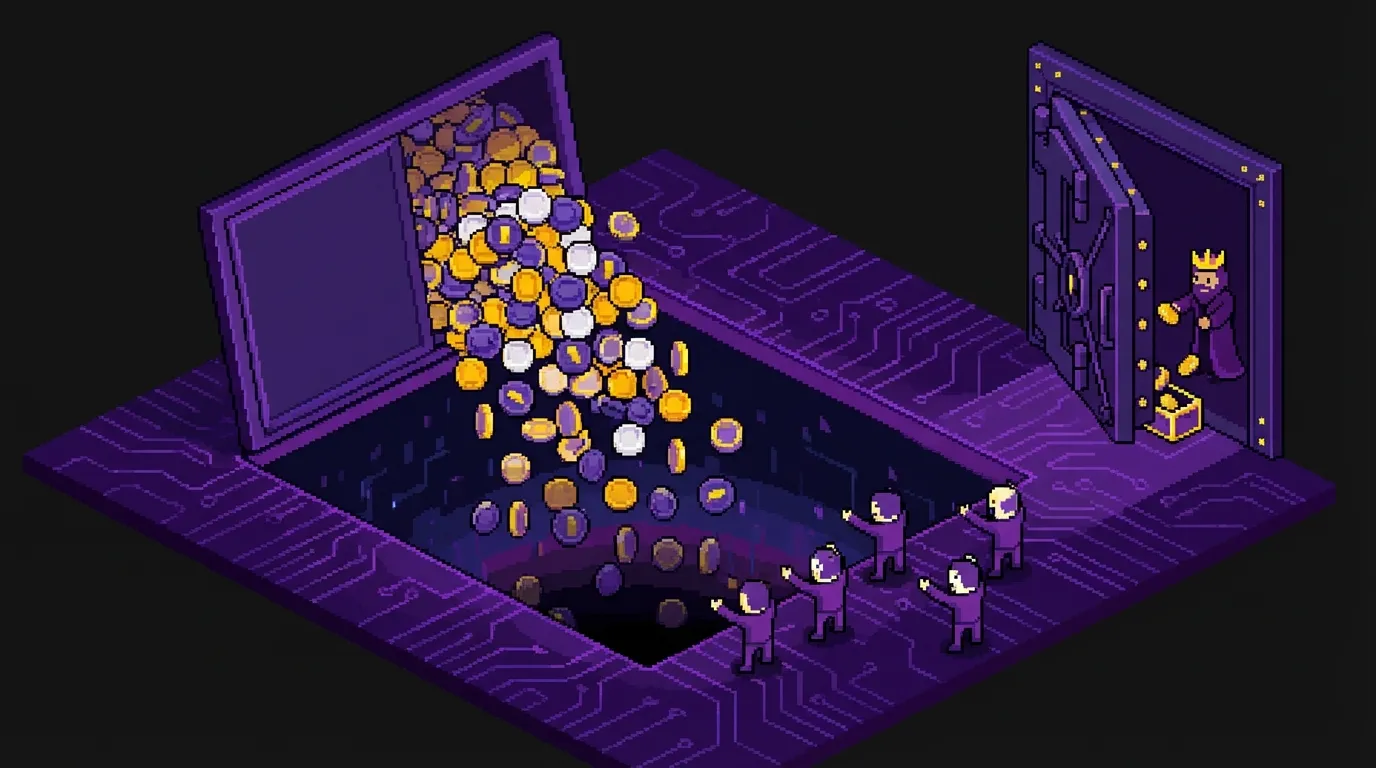
While the majority of traders bled out slowly across hundreds of micro-trades, a small group did extremely well. According to the same data, 250 token deployers extracted roughly $79 million from traders over the past six months.
These 250 wallets launched approximately 194,000 tokens. That's about 1,100 tokens per day, from just 250 addresses. Only around 10 of those tokens ever reached a $5 million market cap.
Think about that for a second. 194,000 launches. 10 hits. The rest? Exit liquidity (the people holding the bag when everyone else leaves) for the deployers.
This isn't a casino where the house has a slight edge. This is a casino where the house builds a new slot machine every 80 seconds, and 99.99% of those machines are rigged to take your coins before lunch.
Pump.fun's Response: Lock the Fees
To Pump.fun's credit, the platform isn't ignoring this.
On March 24, Pump.fun announced a new restriction: token creators now get one chance to redirect their creator fee wallet after launch. After that single change, the fee configuration locks permanently on-chain.
Why does this matter? Because previously, creators could quietly switch who receives the trading fees after a token gained traction. You'd start trading what looked like a community token, and behind the scenes, the fee wallet gets rerouted to the creator's exit address. The platform calls this "griefing," which is putting it mildly.
It's a step in the right direction. But it's a bit like putting a lock on the barn door after 194,000 horses have already left.
The platform also rolled out PumpSwap on March 20, its own decentralized exchange (DEX) that replaces Raydium as the destination for tokens that graduate from the bonding curve (the automatic pricing mechanism that increases price as more people buy). And there's a new "Trader Cashback" model that returns some fee revenue to active traders.
Structural changes? Sure. Enough to flip those 96% numbers? That's a much harder question.
What Drill's Data Adds to the Picture
I've been tracking this from a different angle. Drill scans every new Solana token launch, runs security checks, and tracks each one for 24 hours. The numbers from our end tell a consistent story.
In the last 7 days, Drill tracked 670 new tokens. 95% were hard rejected for failing critical security checks before they ever reached a user's screen. The selection rate, meaning the percentage of tokens that passed every filter, was just 1.49%. That's 10 tokens out of 670.
And here's the kicker: even among those 10 tokens that passed all our filters, the median outcome was 2.07x. Not 10x. Not 50x. About double your money at peak, and that's for the best tokens the algo could find.
→ Related: Why 96% of New Memecoins Fail: Real Data From 835 Tokens
The 96% failure rate from Pump.fun's trader data and the 95% hard rejection rate from Drill's security scans are converging on the same conclusion from completely different directions. One measures wallets, the other measures tokens. Both say the same thing: the overwhelming majority of what launches on Solana right now is not worth your money.
98.6% of All Pump.fun Tokens Have Collapsed
It gets worse when you zoom out. A Solidus Labs report from 2025 analyzed over 7 million tokens deployed on Pump.fun and found that 98.6% collapsed below $1,000 in liquidity, essentially becoming untradeable. Only about 97,000 tokens maintained enough liquidity to be meaningfully traded.
That number is from the token side, not the trader side. But the implication is identical: the base rate for anything launching on Pump.fun approaching "real" status is roughly 1.4%.
→ Related: How to Spot a Rugpull: 5 Warning Signs Anyone Can Check
So What Should You Actually Do?
Look. I'm not going to tell you to stop trading memecoins. That's your call. But the data is clear enough that ignoring it costs money.
Check the deployer. If the wallet that created the token has launched dozens or hundreds of tokens before, that's not a builder. That's a factory. The 250 wallets extracting $79 million averaged 776 token launches each. That pattern is visible on-chain before you buy.
→ Related: How to Check if a Memecoin Creator Has Scammed Before
Size your bets like the data suggests. If 96% of traders make under $500 in a month, your expected value on any single trade is very small. Don't trade money you'd miss. Position sizing (how much you put into each trade) matters more than entry timing in an environment this hostile.
→ Related: When to Sell: The Hardest Decision in Memecoin Trading
Use tools that filter before you see. The whole reason I built Drill was because scanning 670 tokens manually per week is impossible. If 95% are going to get hard rejected on security alone, you need something between you and the firehose.
Watch for the fee structure, not the hype. Pump.fun locking creator fees is meaningful. Tokens launched after March 24 at least have one fewer exploit vector. It doesn't guarantee anything, but it removes one specific way creators were gaming the system.
The Honest Take
Memecoin trading on Pump.fun right now is a game where half the players lose, almost everyone else barely breaks even, and a tiny fraction walks away with life-changing money. The deployers running token factories are printing $79 million while the median trader made less than what you'd earn working a weekend shift.
The data doesn't lie. The question is whether you're going to trade like the 96%, or use it to trade differently.
Sources
- Pump.fun data shows 49% of March traders in the red as platform locks fees — Bitcoin Ethereum News, March 30, 2026
- Over 50% Pump Fun Traders Lose Money as Launchers Extract $79M — CoinEdition, March 25, 2026
- Over 50% of Pump Fun token traders lost money this month, report — Protos, March 24, 2026
- Solana Rug Pulls & Pump-and-Dumps: What Crypto Institutions Must Know — Solidus Labs, 2025
- Drill.meme data, March 24-31, 2026