X Is Locking Crypto Accounts on Sight. Here's What That Means for Memecoins
X's new auto-lock policy freezes accounts posting crypto for the first time. Here's how it works, why it matters for memecoin traders, and what happens when the discovery layer breaks.

Your favorite discovery channel just put up a wall.
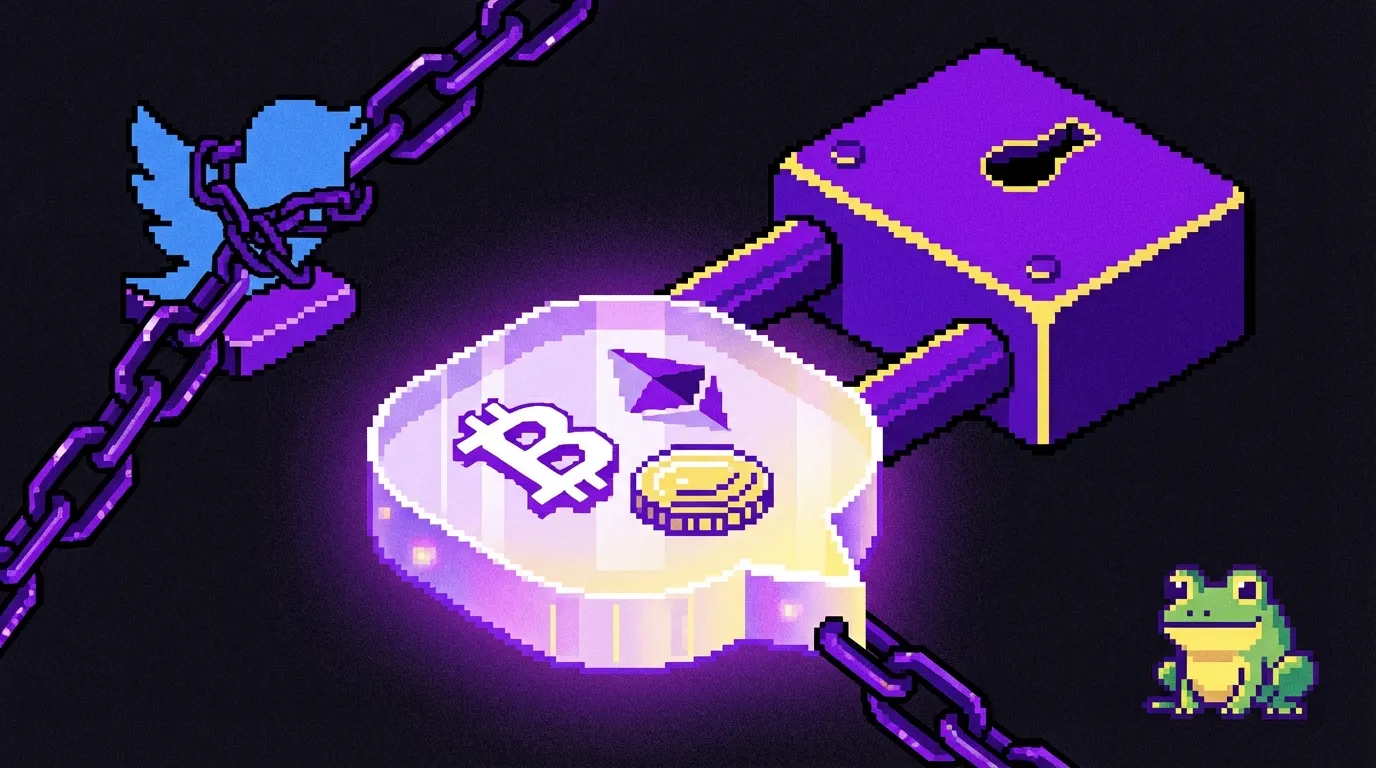
On April 2, X Head of Product Nikita Bier dropped a quiet bomb: the platform is now auto-locking any account that posts about crypto for the first time. Not just new accounts. Any account. If you've had an X profile since 2012 and never once tweeted about Bitcoin, your first crypto mention triggers an instant lock and a mandatory verification process before you can post again.
Bier's exact words: "We are in the process of implementing auto-locking + verification if a user posts about cryptocurrency for the first time in the history of their account."
The stated goal? Kill the scam incentive. And honestly? The reasoning makes sense. But the collateral damage for memecoin traders could be brutal.
What Triggered This
The policy didn't come out of nowhere. X has been drowning in a specific attack pattern for months: hackers compromise a high-follower account (usually through phishing emails disguised as copyright violation notices), strip the owner's two-factor authentication, and immediately start pumping memecoins or posting fake giveaway links.
The Jonathan tortoise incident is the textbook case. On April 1, someone impersonated Joe Hollins, the veterinarian for Jonathan, a 193-year-old tortoise on the island of Saint Helena. The fake account posted that Jonathan had died, then promoted a Solana memecoin called $JONATHAN. The token spiked over 6,000% before crashing to near zero. Jonathan is alive. The vet confirmed it to BBC and The Guardian. The scammer walked away with the profits.
This is the kind of thing that's been happening weekly. And according to Bier, "fake X-trademarked financial scams run rampant on this platform." So X decided to nuke the attack vector at the source.
How the Auto-Lock Actually Works
Here's the mechanism. If an account has zero history of posting about cryptocurrency and then suddenly drops a crypto-related post, X locks the account immediately. The user then has to complete additional verification to prove they're the legitimate owner.
For accounts with 10,000+ followers that start promoting memecoins with no prior crypto history, the requirements are even stricter: mandatory ownership verification before the account is unlocked.
X also rolled out blocks on mass-tagging attacks, where compromised accounts mention dozens of users in a single crypto-promoting post.
Bier claims this should "kill 99% of the incentive" for attackers, since the entire point of hijacking accounts is to use their reach for crypto scams.
According to reports, the system blocked 1.4 million posts and suspended nearly 800,000 bot accounts within the first 24 hours. X's safety team put the false-positive rate at around 1.2%, claiming most legitimate users clear verification in under three minutes.
Why Memecoin Traders Should Pay Attention
Here's the thing nobody's talking about.
Crypto Twitter (CT) isn't just where memecoins get discussed. It's where they get discovered. The entire viral loop that drives memecoin price action starts on X: someone posts about a new token, it gets quote-tweeted, engagement snowballs, more people ape in (buy impulsively), and price pumps.
Break that loop, and you break the discovery engine.
Think about what this policy actually does at scale. Anyone new to crypto who wants to share a find? Locked. Any normie account that spots a trending token and wants to post about it? Locked. Any journalist covering a memecoin story for the first time? Locked.
Yes, they can verify and get unlocked. But friction kills virality. A 12-hour hold on replies and reposts might as well be a lifetime in memecoin trading, where the average hold time has already dropped to 58 seconds.
The math is simple: fewer people posting about tokens = slower viral spread = less buying pressure = lower peaks.
The Data Already Shows a Chill
I pulled the numbers from this week, and the timing is hard to ignore.
In the last 7 days, the algo tracked 577 new Solana tokens. Only 28 passed all security and market health filters, a 4.85% selection rate. Volume is down 19% week over week.
In the last 24 hours alone? 81 tokens tracked. Zero selected. Not one token launched on Easter Sunday weekend passed the filters.
Now, some of that is Easter weekend. Crypto markets always slow down during holidays. But the policy went live on April 2, right as these numbers started cratering. The selection rate actually improved this week (up from 1.69% the week before), meaning the tokens that do launch are slightly better quality on average. But there are just fewer of them. The pipeline is drying up.
Median outcome for tokens that passed this week: 1.74x. Not bad, but down from 2.07x the previous week. The best performer, a Pump.fun token called $durr, hit 5.78x in about two hours before coming back down. The next best, $PEEPO, did 4.25x but took nearly 24 hours to peak.
Translation: the winners still exist, but the overall energy is fading. And when the main discovery channel puts up barriers to entry, that fade accelerates.
The Scam Problem Is Real Though
Let me be clear about something. The problem X is trying to solve is genuine.
Bundle sniping, fake KOL (key opinion leader) endorsements, and hijacked accounts pushing rug pulls have been poisoning the memecoin ecosystem for months. When a trusted account with 200K followers suddenly starts shilling (aggressively promoting) a random token at 3am, people buy. And people lose money.
In the last 30 days, the algo hard-rejected 93.8% of all tokens it scanned. Nearly 94 out of every 100 launches failed basic security checks. That's the environment X is trying to clean up, and the intention is legitimate.
The question isn't whether the policy is well-intentioned. It's whether a blunt instrument like auto-locking every first-time crypto post is the right tool, or whether it cripples legitimate activity along with the scams.
What This Means for How You Trade
If you've been relying on CT for discovery, this is a wake-up call.
The memecoin discovery chain has always been fragile. It depends on a single platform (X), on organic posting by real humans, and on the viral amplification algorithm showing crypto content to the right people at the right time. X just introduced a chokepoint at step one of that chain.
A few practical implications:
New callers get silenced. Callers are accounts that recommend tokens to their audience. Up-and-coming crypto accounts that haven't posted about tokens before will hit the lock wall. The established voices keep posting, but the ecosystem loses fresh perspectives and early discoverers.
Viral spikes get slower. The friction between "someone finds a token" and "that discovery reaches thousands of people" just got longer. In a market where 58-second hold times are normal, even a few hours of delay can mean missing the entire move.
Algorithmic detection matters more. When the social layer gets restricted, tools that scan on-chain data directly become more valuable. The algo tracked 577 tokens this week without needing a single tweet. It doesn't rely on someone posting about a token to discover it.
Telegram and Discord fill the gap. Expect more alpha (early, high-value information) to shift to private channels where X's policies don't apply. This makes public discovery harder but doesn't kill it entirely.
The Bigger Picture
X has been the home of Crypto Twitter for years. But this policy, combined with recent reports of the platform mass-suspending crypto accounts (the #SaveCT movement that popped up this week), signals a shift in the relationship between social media and crypto.
Memecoins in particular are vulnerable here because their entire value proposition is social. A memecoin with no social distribution is just a smart contract nobody knows about. When the platform that powers that distribution starts adding friction, the whole model gets stress-tested.
The 1.2% false-positive rate sounds small. But 1.2% of millions of users is tens of thousands of people who get wrongly locked just for mentioning crypto. And every one of those false positives is someone who might not bother posting about crypto on X again.
Real Talk
The scam problem on X was out of control. Something had to change. But the fix X chose is the digital equivalent of banning everyone from entering a store because shoplifters exist.
The tokens that actually matter, the ones with real community and organic activity, will survive a quieter CT. The ones that only existed because of viral hype loops and bot amplification? Those are going to struggle.
If your trading strategy depends entirely on "I saw it trending on CT," you need a second source. Whether that's on-chain scanning, algorithmic alerts, or private communities, the era of X being the single discovery layer for memecoins might be ending.
The algo doesn't need X to find tokens. It scans the chain directly. But for the broader market, this is a structural shift worth watching closely.
Sources
- X (Twitter) Targets Scams by Locking First-Time Crypto Posts — Finance Magnates
- Crypto Users Beware: X's New Rules Could Get You Banned — NewsBTC
- X Introduces Account Locking Against Crypto Scams — COINOTAG
- X Auto-Locks First Crypto Posts; Selfie Checks Block 1.4M Posts — GN Crypto
- Alive and well: Solana memecoin honoring 193-year-old tortoise Jonathan rallies following April Fools' prank — The Block
- Drill.meme data, March 29 to April 5, 2026